
Holiday cooking puts countertops to work.
Between preparing large meals, serving drinks, baking desserts, entertaining guests, and cleaning up afterward, your kitchen surfaces may experience more activity in a few weeks than they normally do in months.
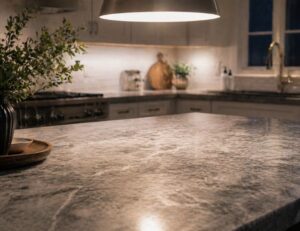
For homes with marble, granite, or other natural stone countertops, a little preparation can help reduce unnecessary damage.
At Natural Stone Services, we recommend understanding what can affect your particular stone rather than treating every countertop like an indestructible work surface.
Here are several ways to help protect natural stone while still enjoying your kitchen throughout the holidays.
Know What Type of Stone You Have
Good countertop care starts with knowing what you’re maintaining.
Marble and granite are both natural stone, but homeowners shouldn’t assume they will respond identically to every substance, cleaning product, or form of damage.
Knowing your surface can help you make better decisions when something spills or a mark suddenly appears.
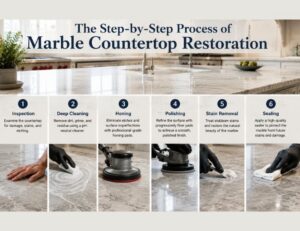
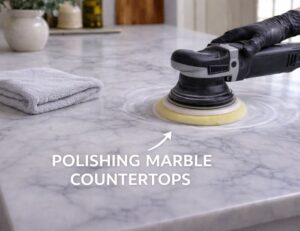
Natural Stone Services provides specialized services for both marble honing, polishing, and sealing and granite honing, polishing, and sealing.
Clean Spills Promptly
During a holiday gathering, it’s easy to say, “I’ll clean that later.”
With natural stone, prompt attention is generally the better habit.
Food preparation and entertaining can expose countertops to many different substances. Instead of allowing spills to remain on the surface throughout a gathering, clean them appropriately when you notice them.
If a mark remains after cleaning, don’t immediately assume you need to scrub harder.
Natural Stone Services has a guide addressing whether you can remove a stain from a stone countertop.
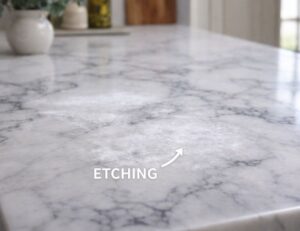
Understand the Difference Between Staining and Etching
A cloudy or dull mark on a countertop isn’t necessarily a stain.
With marble in particular, etching can change the appearance of the surface.
That distinction matters because trying to treat an etch like an ordinary stain may not produce the result you’re expecting.
Our article on what causes marble countertop etching explains this issue in more detail.
Don’t Experiment With Aggressive DIY Treatments
When a mark doesn’t disappear, homeowners may be tempted to try stronger cleaners or improvised treatments.
That can be risky when you don’t know exactly what you’re treating.
Before experimenting, identify whether you’re dealing with residue, staining, etching, scratching, or another form of surface damage.
Use Appropriate Protection During Food Preparation
Holiday cooking can involve heavy cookware, serving pieces, bottles, utensils, and countless ingredients moving across the countertop.
Avoid treating your natural stone as a cutting board or general-purpose workbench.
Appropriate cutting boards, trivets, coasters, and other protective items can create a useful barrier between holiday activity and the stone itself.
Small precautions are easier than trying to correct preventable surface damage afterward.
Don’t Ignore the Condition of Your Sealer
Sealing is an important part of the natural stone conversation, but homeowners sometimes assume a sealed surface is permanently protected from everything.
It isn’t that simple.
Natural Stone Services explains whether sealing stone surfaces is necessary and has also covered what can happen when stone countertops aren’t sealed.
If you’re unsure about your countertop’s current condition, professional evaluation can help you determine what care is appropriate.
Watch for Scratches and Chips
Holiday gatherings bring more people—and more objects—into the kitchen.
Heavy serving pieces, cookware, decorations, and other items can accidentally impact or scratch a stone surface.
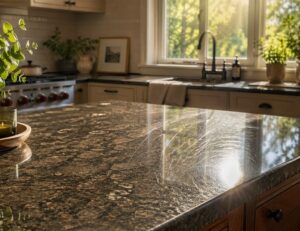
If granite becomes scratched, the answer isn’t necessarily replacement.
Professional granite repair and restoration options may be available depending on the damage.
Natural Stone Services also provides marble repair for marble surfaces requiring professional attention.
Be Careful During Holiday Cleanup
The meal is over, guests have gone home, and now you want the kitchen clean as quickly as possible.
This isn’t the best time to grab an unfamiliar cleaner and use it across every surface.
Follow care methods appropriate for your particular stone.
Natural Stone Services’ natural stone maintenance guide provides additional information about cleaning, polishing, and sealing.
If your countertops already look dull, aggressive cleaning may not be what they need.
What If the Damage Is Already There?
Holiday activity may not cause the problem—it may simply make an existing problem more obvious.
Bright kitchen lighting, gatherings, and increased use can draw attention to scratches, etching, dull areas, chips, stains, or uneven finishes you’ve been ignoring.
That’s where professional countertop restoration can become part of the conversation.
The goal is to evaluate the actual condition of the stone and determine whether cleaning, repair, polishing, resurfacing, or restoration is appropriate.
Enjoy Your Kitchen Without Treating Your Stone Like a Museum Piece
Natural stone is meant to be part of your home.
Protecting it doesn’t mean spending the holidays worrying every time someone sets down a glass.
Good habits can go a long way: clean spills appropriately, use protective barriers when needed, understand your stone, and avoid aggressive DIY treatments when damage appears.
When ordinary maintenance isn’t enough, Natural Stone Services can help determine what your countertops need.
Explore our natural stone services or contact Natural Stone Services if you’d like professional help with your countertops.
Key Takeaways
- Holiday cooking and entertaining can expose stone countertops to increased wear.
- Marble and granite shouldn’t automatically be maintained exactly the same way.
- Address spills promptly using methods appropriate for your stone.
- Staining and etching are different problems.
- Cutting boards, trivets, and other protective items can help reduce avoidable damage.
- Sealing doesn’t make natural stone immune to every type of damage.
- Avoid aggressive DIY treatments when you aren’t sure what caused a mark.
- Existing countertop damage may be repairable or restorable without replacing the entire surface.